The Honest Guide Most Duct Cleaning Companies Don’t Want You to Read.
Let’s Be Straight With You First
Most blogs about DIY duct cleaning either tell you it’s completely fine to do yourself or scare you into thinking you’ll destroy your home if you try.
Neither is fully true.
Here’s the real answer:
There are parts of your duct system you can clean yourself. And there are parts that absolutely require a professional.
This guide will tell you exactly which is which so you don’t waste a Saturday doing a job that won’t actually solve the problem, and you don’t spend money on a professional call for something you could’ve handled in an hour.
If you’re a Gatineau homeowner who wants to take care of your home and breathe cleaner air read every word of this.
First: Why Do Air Ducts Get Dirty in Gatineau?
Your duct system is essentially a highway for air. Every time your furnace or AC runs, air travels through that highway and it brings passengers: dust, pollen, pet dander, mold spores, insulation fibers, and whatever else is floating around in your home.
Over time, these particles settle on duct walls. They build up in corners and bends. They coat your blower blades and clog your coils.
Gatineau makes this worse than most cities for a few reasons:
- Six months of heavy furnace use more airflow means faster buildup
- Étés humides moisture in ducts creates perfect mold conditions
- Spring pollen season, the Outaouais region produces heavy pollen from trees, grasses, and wildflowers
- Older homes in Hull, Aylmer, and Buckingham aging ductwork with decades of accumulated debris
- Winter salt and particulates tracked indoors gets pulled into return vents near floors and baseboards
The result? Most Gatineau homes have dirtier ducts than their owners realize.
What Happens When You Don’t Clean Your Ducts?
Before we get into the how let’s understand the why.
Dirty air ducts cause real, measurable problems:
Your air quality suffers. Every time your HVAC runs, it recirculates whatever is in your ducts. Dust, mold spores, and allergens get pushed into every room.
Your energy bills go up. Buildup on your blower and coils forces your system to work harder. A restricted system uses more energy to do the same job.
Your HVAC breaks down sooner. Dust-coated motors overheat. Clogged coils freeze. Parts wear out years before they should.
Your family’s health takes a hit. Dirty air ducts are a known trigger for allergies, asthma flare-ups, headaches, and chronic fatigue especially in children and the elderly.
The good news? You can do something about it today.
The Honest Truth About DIY Duct Cleaning
Here’s what the industry won’t always tell you:
A full, professional-grade duct cleaning requires truck-mounted vacuum equipment that generates hundreds of inches of water column in suction pressure.
Your household vacuum? It generates roughly 60 to 80 inches of water column. That’s less than 20% of what professional equipment produces.
That doesn’t mean DIY duct maintenance is pointless. It means you need to be honest about what you’re doing maintenance cleaning versus what a professional does restoration cleaning.
DIY maintenance removes surface dust and debris from accessible areas. It freshens your system and delays buildup. It’s worth doing.
But if your ducts haven’t been professionally cleaned in 5+ years, or if there’s mold in the system, or if you’re dealing with serious allergy symptoms DIY alone won’t solve it.
Do both. Start with DIY maintenance. Finish with a professional cleaning when needed.
What You’ll Need Before You Start
Gather these before you begin:
- Heavy-duty vacuum with a hose attachment, the more powerful the better; a shop vac is ideal
- Microfibre cloths at least 6 to 10
- Stiff-bristle brush a toilet brush or bottle brush works well for reaching inside duct openings
- Screwdriver to remove vent covers (usually Phillips head)
- Paper towels or old rags for covering vents during cleaning
- Furnace filter (new) have a replacement ready before you start
- Flashlight or phone torch to inspect inside duct openings
- Dust mask (N95 recommended) you will stir up a lot of particles
- Safety glasses, especially when cleaning ceiling vents
- Mild dish soap and warm water for washing vent covers
- White vinegar natural deodorizer for duct interiors
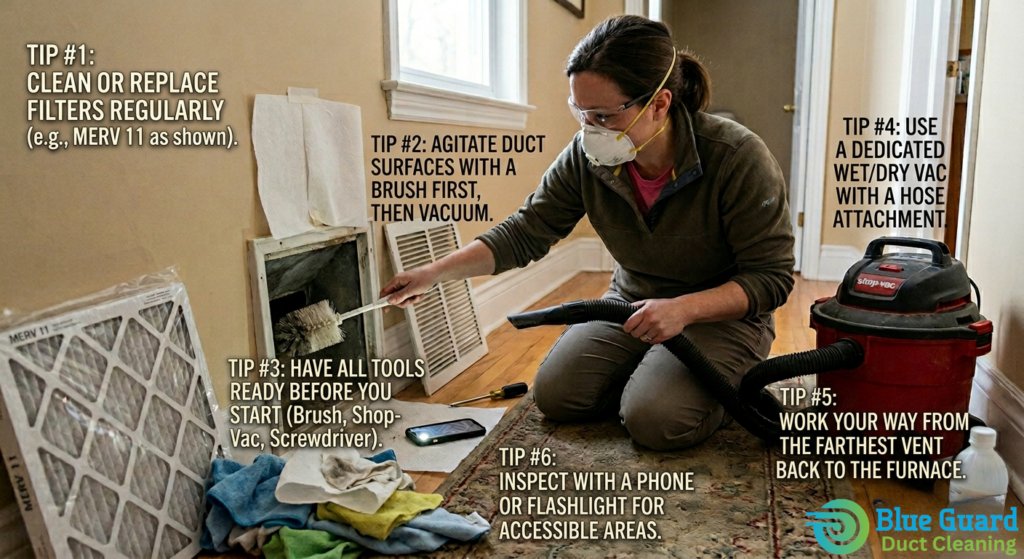
Step-by-Step: How to Clean Air Ducts Yourself in Gatineau
Step 1 : Turn On the Fan, Turn Off the Heat/Cool
Set your thermostat to Fan Only mode not Heat or Cool. This keeps air moving through the system during cleaning, which helps carry loosened debris toward the filter. It also prevents your furnace from firing up while you work.
If your system doesn’t have a Fan Only setting, turn the system completely off at the thermostat.
Step 2 : Cover Supply Vents with Paper Towels
Walk through your home and loosely cover every supply vent (the vents that blow air out) with a paper towel or cloth, tucked behind the vent grille. This prevents dislodged dust from blowing into rooms while you work on the return side.
Supply vents blow air out. Return vents pull air in. Supply vents are usually smaller. Return vents are larger — often on walls or ceilings and you can feel the suction when the fan is on.
Step 3 : Loosen Dust Inside the Ducts
Starting with the return vents, remove the cover and use your stiff-bristle brush to loosen dust buildup on the inner duct walls reach in as far as you safely can. Work the brush back and forth along all four walls of the duct opening.
Do this at every vent opening in your home both supply and return.
This agitation step is critical. Dust sticks to metal duct walls. You need to physically break it loose before vacuuming can capture it.
Step 4 : Vacuum Every Vent Opening
With your shop vac or vacuum hose at full power, vacuum inside each duct opening sucking up all the debris you just loosened. Hold the hose flat against each wall of the duct opening and work your way in as far as the hose reaches.
Don’t rush this step. Spend 2 to 3 minutes at each vent.
Step 5 : Remove and Wash All Vent Covers
Unscrew every vent cover and grille in your home. Bring them to the sink or bathtub and wash with warm water and mild dish soap. Use a stiff brush to scrub away dust and buildup from the grille fins.
Rinse thoroughly and let them air dry completely before reinstalling wet covers can promote rust on metal grilles.
Step 6 : Clean the Return Air Plenum (If Accessible)
The return air plenum is the large box that connects your return ducts to your furnace or air handler. On many Gatineau homes, this is accessible by removing a panel on the furnace unit.
If accessible: vacuum the interior thoroughly, wipe down the walls with a damp microfibre cloth, and check for any visible mold or standing water.
If not accessible or you’re not sure: leave this for the professional.
Step 7 : Clean the Blower Compartment (If Comfortable)
On most furnaces, you can access the blower compartment by removing the lower front panel. The blower motor and fan blades accumulate thick dust over time, this buildup directly impacts your HVAC efficiency.
If you’re comfortable: use your vacuum to carefully remove dust from the blower blades and surrounding compartment. Don’t touch any wiring.
If you’re not comfortable with this: leave it for BlueGuard. This is one of the highest-impact parts of a professional cleaning.
Step 8 : Replace the Furnace Filter
Now is the perfect time. A brand-new filter at the end of your cleaning session means your system starts fresh capturing new particles instead of recirculating the ones you just dislodged.
Choose a MERV 8 to 11 filter for most Gatineau homes. Install it with the airflow arrow pointing toward the furnace.
Step 9 : Wipe Down Vent Covers and Reinstall
Once the vent covers are fully dry, wipe them down one more time with a dry microfibre cloth and reinstall them at every vent opening. Make sure they sit flush with no gaps, gaps mean unfiltered air bypasses your system.
Step 10 : Run the System and Check
Remove the paper towel covers from your supply vents. Turn your system back to normal operation. Let it run for 15 to 20 minutes and then walk through your home.
Check: Does the air smell fresher? Are vents blowing more freely? Is there less dust settling on nearby surfaces?
If yes, your DIY maintenance cleaning worked.
If you still notice musty odors, weak airflow, or dust the problem is deeper in your system than DIY can reach.
The Parts You Cannot Clean Yourself
Be honest about these. DIY cleaning does not replace professional service for:
Inside the ductwork beyond arm’s reach the first 30 to 60 cm of duct is all you can realistically access. The rest of your duct system often hundreds of metres of metal passages remains untouched by household vacuums.
The evaporator coil located inside the air handler, this component requires professional tools and knowledge to clean safely. Damaging the coil is an expensive mistake.
Mold anywhere in the system if you find mold during your DIY inspection, stop and call a professional. Disturbing mold without proper containment spreads spores through your home.
The main trunk lines the large central ducts that run through your basement or attic carry the most accumulated debris. These require professional vacuum attachment and agitation tools to clean properly.
Dryer vents your dryer exhaust runs from the dryer to an exterior vent cap, often through walls and around corners. A clogged dryer vent is a fire hazard. This is not a DIY job.
How to Know If Your Gatineau Home Needs a Professional Cleaning
DIY maintenance is great for upkeep. But these situations require BlueGuard:
| Situation | Action Required |
|---|---|
| Last professional cleaning was 3+ years ago | Book a full cleaning |
| You can see mold inside any duct opening | Call immediately |
| Musty smell persists after DIY cleaning | Professional inspection needed |
| Family members have unexplained respiratory symptoms | Professional inspection needed |
| You recently renovated or did major construction | Full cleaning recommended |
| You just moved into a home with unknown history | Full cleaning before settling in |
| Ducts in a home built before 1990 | Full cleaning decades of buildup |
| Dryer takes more than one cycle to dry clothes | Dryer vent cleaning needed urgently |
DIY Cleaning vs. Professional Cleaning Side by Side
| DIY Cleaning | BlueGuard Professional | |
|---|---|---|
| Vent covers and grilles | ✅ Yes | ✅ Yes |
| First 30–60 cm of duct | ✅ Yes | ✅ Yes |
| Full duct interior | ❌ No | ✅ Yes |
| Lignes principales | ❌ No | ✅ Yes |
| serpentin d'évaporateur | ❌ No | ✅ Yes |
| Blower motor deep clean | ❌ No | ✅ Yes |
| Mold treatment | ❌ No | ✅ Yes |
| Dryer vent | ❌ No | ✅ Yes |
| Written service report | ❌ No | ✅ Yes |
| NADCA certified | ❌ No | ✅ Yes |
How Often Should Gatineau Homeowners Clean Their Ducts?
DIY maintenance cleaning: Every 6 to 12 months do it when you change your clocks or at the start of heating and cooling seasons.
Professional HVAC cleaning: Every 3 to 5 years for most Gatineau homes. Every 2 to 3 years if you have pets, allergies, an older home, or recent renovations.
The combination of regular DIY upkeep and periodic professional cleaning gives you the best air quality and the most cost-effective system performance.
BlueGuard Gatineau’s NADCA-Certified Duct Cleaning Experts
When your DIY cleaning reaches its limit BlueGuard takes over.
We serve all of Gatineau including Hull, Aylmer, Gatineau sector, Buckingham, Masson-Angers, and Pointe-Gatineau and we bring commercial truck-mounted equipment that reaches every corner of your duct system, not just the parts near the vents.
What BlueGuard delivers:
- ✅ NADCA-certified technicians
- ✅ Truck-mounted commercial vacuum systems
- ✅ Full duct cleaning every supply and return line
- ✅ Blower motor and evaporator coil cleaning
- ✅ Dryer vent cleaning available
- ✅ Antimicrobial sanitization treatment available
- ✅ Bilingual service English and French
- ✅ Transparent upfront pricing
- ✅ Written service report after every job
Ready for a Professional Clean? Book Today.
You’ve done the DIY. You’ve freshened up the accessible parts.
Now let BlueGuard handle the rest the deep clean that reaches every metre of your ductwork and leaves your Gatineau home breathing like new.
📞 Call 1-844-498-8364 📧 sales@blueguard.ca 🌐 blueguard.ca
Free quote. No obligation. Fast scheduling across Gatineau and Ottawa.
Frequently Asked Questions
Can I really clean my air ducts myself?
Yes partially. You can clean vent covers, grilles, and the first section of duct openings with a vacuum and brush. But the deep interior of your ductwork, evaporator coil, and blower motor require professional truck-mounted equipment to clean properly. DIY is great for maintenance; professional cleaning is needed for restoration.
How do I know if my Gatineau ducts need professional cleaning?
If it’s been 3 or more years since a professional cleaning, if you notice musty odors after DIY cleaning, if dust keeps returning quickly, or if anyone in your home has unexplained respiratory symptoms, it’s time to call BlueGuard for a full inspection and cleaning.
Is DIY duct cleaning worth the effort?
Absolutely. Regular DIY maintenance cleaning vent covers, vacuuming accessible duct openings, and replacing filters reduces buildup between professional cleanings, improves airflow, and helps your system run more efficiently. Think of it as brushing your teeth between dental appointments.
What’s the best vacuum for DIY duct cleaning?
A shop vac with a long flexible hose attachment gives you the best results for DIY cleaning. Standard household vacuums can work for vent covers and grilles but lack the suction power to effectively clean inside duct openings.
How long does DIY duct cleaning take in an average Gatineau home?
For a typical 3 to 4 bedroom Gatineau home, expect 2 to 3 hours for a thorough DIY cleaning including removing and washing all vent covers, vacuuming duct openings, and replacing the filter.
Does BlueGuard offer service in all parts of Gatineau?
Yes. BlueGuard serves all Gatineau sectors Hull, Aylmer, Gatineau, Buckingham, Masson-Angers, and Pointe-Gatineau as well as Ottawa and surrounding communities across the National Capital Region.
Can dirty ducts cause health problems?
Yes. Dirty air ducts recirculate dust, mold spores, pet dander, and allergens through your home every time your HVAC runs. This is a known trigger for allergies, asthma, headaches, fatigue, and respiratory irritation especially in children, elderly residents, and anyone with existing breathing conditions.